


Meta-Harness Summer: The Missing Layer in Your AI Agent Plan
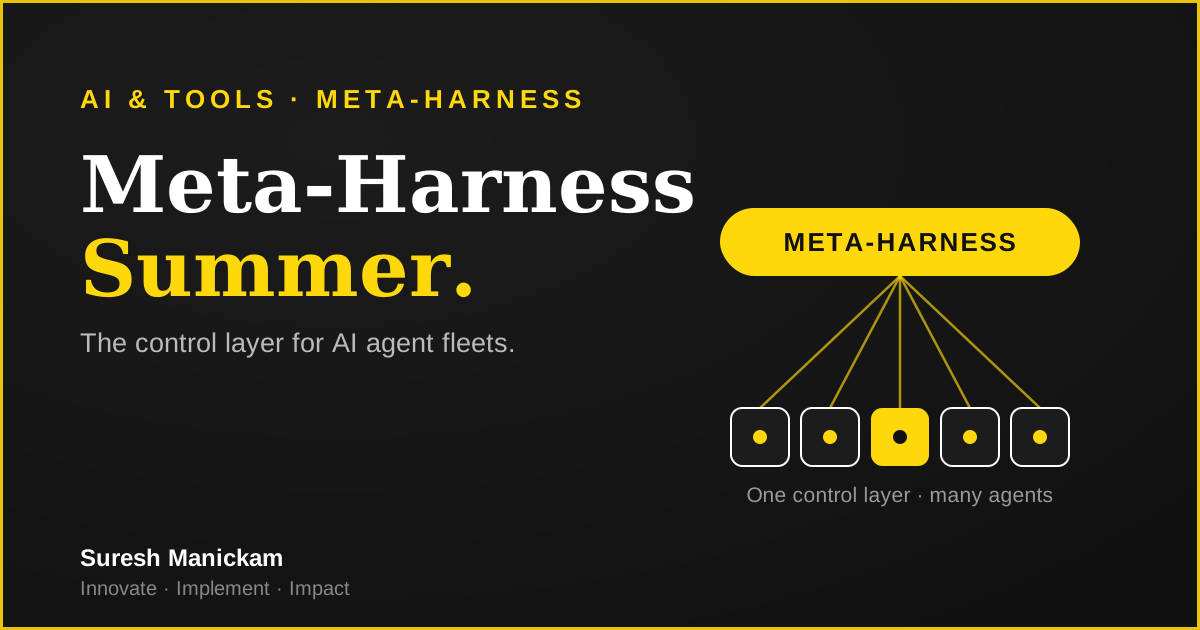
If your AI pilot today is one clever agent doing one job, the big news of June was not a new model. It was a quiet pile-up of launches that all solve the next problem: what happens when you have not one agent, but a hundred.
Latent Space called it "Meta-Harness Summer", and the name is sticking. In the space of a single week, Databricks, Cloudflare, Vercel, Cognition and a handful of others each shipped a "meta-harness". Different companies, no coordination, almost the same idea. That kind of convergence is usually the tell that a new standard is about to form.
First, what is a harness, and a meta-harness?
A model on its own just predicts text. A harness is the scaffolding around it that turns it into an agent that can actually do work: the environment it runs in, the tools it can call, the guardrails that keep it safe, and the memory that keeps it on track. It is the difference between a clever chat reply and a task that gets finished.
A meta-harness sits one level up. It is the control layer for many agents at once: how you run a whole fleet of them reliably, securely, and under some kind of governance. The easiest way to picture it: if a single container could run on its own, a thousand containers needed Kubernetes. Agents have just reached their Kubernetes moment.
Why everyone shipped one the same week
The loudest bet is Databricks. Its CTO, Matei Zaharia, is backing an open-source project called Omnigent, described as "an open source, pluggable architecture for pulling in any coding or knowledge work agent into a standardised, secure, reliable, scalable system." Around it landed Cloudflare's Flue, Vercel's Eve and HarnessAgent, Cognition's OpenInspect, Zed's ACP and more, all within days.
Latent Space's own read is blunt: some open architecture "will probably win, if only because it is currently being independently rediscovered at 1000 AI native shops." When the same shape is reinvented in a thousand places at once, it stops being a feature and starts becoming infrastructure. The last time the industry felt like this was right before MCP arrived and quietly became the way agents talk to tools.
What this means for you
A few practical takeaways if you are planning AI for a real business, not a demo.
- Do not buy an agent, plan for a fleet. A single pilot is easy. The hard and expensive part is the tenth agent and the hundredth: running them, watching them, and stopping them when they misbehave. Budget for that control layer now, not after it hurts.
- Governance belongs in the harness, not in a memo. Access control, logging, approvals and a kill switch should live in the layer every agent runs through, not in a policy you trust people to remember.
- Lean open where you can. With the standard still forming, an open and pluggable layer keeps you from betting the business on one vendor's agent format. That is exactly the bet Databricks is making out loud.
One honest caveat: it is early, and nobody knows yet which meta-harness wins, or whether today's names are even the ones that last. But the layer itself is not hype. If your AI roadmap stops at "we are trying a few agents", Meta-Harness Summer is the nudge to plan the layer that will run them, before you have a hundred of them and no clean way to keep them in line.